Traditions
J'ouvert in Trinidad: Meaning, History and How to Play
By Soca Carnival EditorsUpdated 9 min read
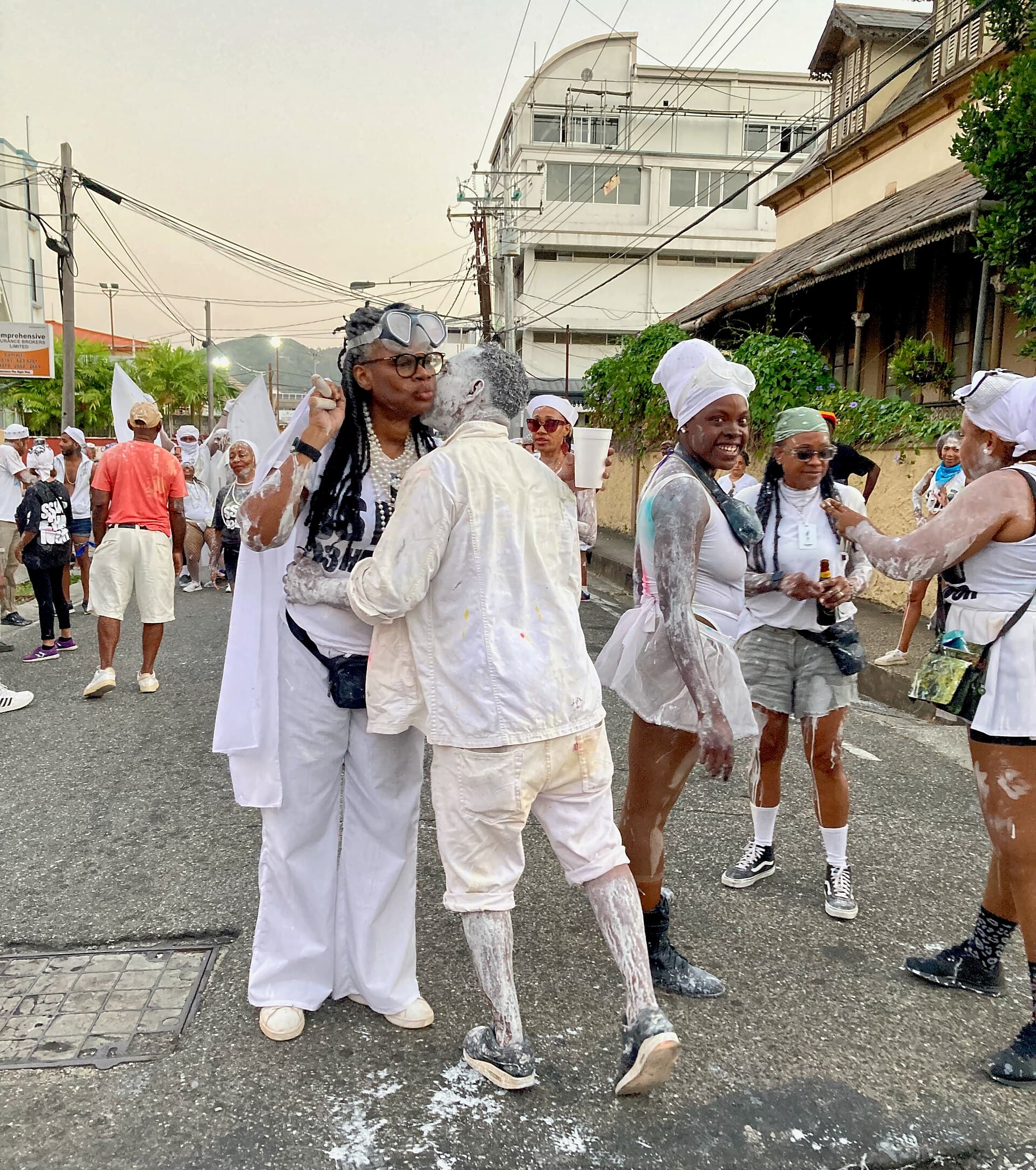
Image credit: Trini.lise, via Wikimedia Commons, CC0
Before the feathers, before the sequins and the big Tuesday bands crossing the stage, Trinidad Carnival begins in the dark. Somewhere around Port of Spain a music truck coughs into life, a few hundred people in old T-shirts start to move, and someone uncaps a bottle of paint. By the time the sun comes up over the Northern Range, thousands of strangers are covered in the same mud, singing the same chorus, and nobody can tell a banker from a bus driver. That is J'ouvert.
If you only experience one part of Carnival, many Trinis will tell you to make it this one. Here is where it came from, what it means, and how to play it well.
What does J'ouvert mean?
The name comes from the French jour ouvert, "day open", or from the Creole jou ouvé, often glossed as "is it daybreak yet?"1 You will hear it said "joo-VAY", and you will see it spelled J'ouvert, Jouvert, Jouvay or Jour Ouvert. All of them point to the same moment: the hours before and just after dawn on Carnival Monday, when Carnival officially opens.
That French Creole word is a clue to the festival's history. Carnival arrived in Trinidad with French and French Creole planters in the late 18th century, and many of Carnival's oldest words, from jab (devil) to jamette and lavway (the stickfight chant), come from French patois.2
From Canboulay to daybreak: the roots of J'ouvert
J'ouvert grows directly out of Canboulay (from cannes brûlées, "burnt canes"). During slavery, when fire broke out in the cane fields, enslaved people from surrounding estates were rounded up and marched to the spot with horns, shells and drivers' whips to save the crop. After emancipation, Africans turned that memory into a celebration of freedom: torchlit processions with drumming, singing, stickfighting and masking, first held on 1 August and later moved into the Carnival season, starting at midnight on Carnival Sunday.2
By the 1870s the Canboulay had become a huge night procession through Port of Spain, with hundreds of masked men carrying lighted flambeaux and sticks, drumming and singing.3 The colonial authorities saw it as disorder. In 1881 police chief Captain Arthur Baker tried to stop it and was beaten back in a street fight that injured 38 of his 150 men.3 In late 1881 a proclamation allowed lit torches only from midnight on Carnival Sunday to 5am on Carnival Monday, and only in open spaces such as the Queen's Park Savannah.4 Then the Peace Preservation Ordinance, passed just before the 1884 Carnival, allowed the authorities to ban torchlight processions and large street bands.3
The people did not stop. They moved. With the night-time Canboulay suppressed, the celebration settled into the hours of daybreak on Carnival Monday. The National Library (NALIS) puts it simply: Canboulay was abolished in 1884 and replaced by a restricted festival at dawn on the Monday before Ash Wednesday, and J'ouvert "became well established", with tamboo bamboo taking the place of the banned African drums.2 (Read the full story in our Canboulay history.)
So when you are standing in the dark on Carnival Monday morning waiting for the truck to move, you are standing in the space that the descendants of enslaved Africans fought to keep.
The characters of the dawn
J'ouvert is the home of "ole mas" (old mas): costumes made from whatever was at hand, and characters that mocked the powerful. Writing in the Trinidad Guardian, D Anthony Blackman described ole mas as "old clothing, and old anything you could put your hands on", played with oil or mud and full of satire and caricature of current issues.5
Jab molassie
The signature J'ouvert character is the jab molassie, the molasses devil. Jab is French patois for diable (devil) and molassie comes from mélasse (molasses). The National Carnival Commission traces it to the sugar estates, where freed people daubed themselves with molasses, a by-product of the cane they had been forced to cut, as a cheap and readily available disguise.6 NALIS describes the costume as short pants, a mask and horns, chains, locks and keys around the waist and a pitchfork, with the body smeared in grease, tar, mud or coloured dye. Imps beat out a rhythm on tins while others hold the jab's chain, as if restraining him while he strains and "wines" against it.2
Blackman sees that smearing tradition as the reason J'ouvert still runs on oil and mud today.5
Blue devils and other jabs
Over time the jab molassie has branched into blue, red, green, white and yellow devils, and jabs covered in mud or chocolate.6 The most famous are the blue devils of the mountain village of Paramin, who come out in their own village on Carnival Monday, leaping and writhing to biscuit-tin drums and threatening to rub their paint on anyone who will not "pay the devil" a dollar or two.1,6 Treat them with good humour: pay up, or accept that you will go home blue.
Mud, paint, oil, powder and cocoa
Most modern J'ouvert bands are organised around what you will be covered in. There are mud bands, paint bands, powder bands, oil bands and chocolate or cocoa bands.7,1 Some neighbourhoods have their own preferences: at the 2025 J'ouvert in Sangre Grande, a crowd police estimated at 10,000-12,000 mostly skipped the mud for coloured paint and powder.8
Satire and traditional characters
J'ouvert has always been political. Bands have long used the morning to mock politicians, scandals and the news of the day with homemade costumes and placards. Some bands keep the full theatre of traditional mas alive: Chaguanas band Jouvert Junkiez, for example, presents a folklore-based theme each year with a King and Queen and a monologue at the stage crossing.9 You may also see midnight robbers and dame lorraines sharing the road with the mud.7
How J'ouvert works today
Timing. Every year the government publishes a Public Festivals (Carnival) Order fixing the official Carnival period. For 2026 it ran from 4am on Monday 16 February to midnight on Tuesday 17 February.10,11 J'ouvert is the first event of that window. Revellers gather earlier in the dark (in Sangre Grande in 2025 they were assembling from 3:30am for the 4am start8) and the mas carries on well past sunrise into the morning. NALIS records that in the mid-20th century J'ouvert ran from 4am to noon on Carnival Monday;2 today most bands finish in the mid to late morning, leaving time to shower and rest before Monday's pretty mas. For Carnival 2027, J'ouvert falls in the early hours of Monday 8 February 2027 (see our J'ouvert 2027 listing and the full Trinidad Carnival 2027 dates). Your band will confirm its own meeting point and start time.
Where. The biggest concentration of bands is in Port of Spain,1 but other towns hold their own J'ouvert too, from Sangre Grande in the east8 to Chaguanas in central Trinidad.9
Bands and packages. You can technically play J'ouvert for free by following a band, but most visitors register with a J'ouvert band in advance. A typical package includes a band T-shirt or simple costume and the band's paint, mud or powder, and many bands add drinks, breakfast and private security.7 Bands range from a few hundred people to around a thousand: at Carnival 2008 the writer Barbara Ehrenreich described her band, 3canal, and 14 other J'ouvert bands assembling around Port of Spain, each several hundred to a thousand strong, each with its own music and colours.1 Chaguanas band Jouvert Junkiez plays with about 800 masqueraders a year.9 To compare packages, browse the Trinidad J'ouvert bands we list, such as J'ouvert Jumbeez.
Music. The engine is a music truck with a DJ or live band, though steelbands and rhythm sections still appear on the road with some bands.
What to wear and bring
- Old clothes you can throw away. Paint, oil and cocoa may never wash out. A plain T-shirt or the band's shirt and old shorts are standard.
- Closed shoes with grip. Streets get wet and slippery and feet get stepped on. Old sneakers you can bin afterwards are ideal; avoid sandals and slippers.
- Protect your eyes. Cheap swim goggles or old sunglasses help when the paint starts flying.
- A waterproof pouch. Keep your phone, ID, a little cash and your band wristband in a sealed bag, ideally on a lanyard or under your clothing.
- Leave valuables at home. No jewellery, no expensive watch.
- Water. It is hot, crowded and you will be moving for hours.
Staying safe and being a good guest
- Stay with your lime. Agree a meeting point with your friends before you start, because phones die and crowds split.
- No glass. For Carnival 2026, government regulations banned glass bottles in Port of Spain and other Carnival zones for the whole Carnival period, with a TT$1,000 fine and up to six months in prison for breaches.10 Check the 2027 regulations when they are gazetted.
- Ask before you paint. Covering strangers is part of the fun, but read the person. Children, spectators in good clothes and people clearly on their way to work deserve a pass.
- Respect the devils. If a jab asks you to pay, pay or laugh and move along. It is a performance with a long history.
- Pace yourself. J'ouvert is a marathon that starts in the middle of the night. Eat before, drink water, and arrange a safe ride home.
- Mind your mud. Expect to be wiped, hugged and splashed. If you do not want to be touched, J'ouvert is best watched from a balcony.
J'ouvert vs pretty mas
Carnival has two moods, and J'ouvert is the first.
| At a glance | J'ouvert | Pretty mas |
|---|---|---|
| When | Before dawn into Carnival Monday morning | Carnival Monday afternoon and all of Carnival Tuesday |
| Costume | Old clothes, mud, paint, oil, powder, devil horns, homemade satire | Designed costumes, beads, feathers, headpieces |
| Spirit | Anonymous, levelling, irreverent, rooted in Canboulay and ole mas | Spectacle, presentation and competition |
| Judging | Some J'ouvert competitions, but most people play for the feeling | Bands judged crossing stages for Band of the Year |
Smithsonian's Ehrenreich, who played J'ouvert with the band 3canal, described how the paint dissolved race, age and gender in the crowd: "there can be no spectators, only participants, and everyone must be anointed."1 Pretty mas came later and grew partly out of efforts by the upper classes to tone down the African-derived side of the festival.1 J'ouvert is where that older, rougher, more democratic Carnival still lives. (See how pretty mas evolved.)
Why J'ouvert matters
Blackman wrote that J'ouvert and ole mas were the ancestors' way of casting their former masters as devils from hell.5 Jouvert Junkiez bandleader Ganesh Kalliecharan describes the roots of J'ouvert as "a story about slavery, emancipation and British colonialism", a struggle by enslaved people for the right to celebrate freely on the streets.9 Play it for the party by all means, but know that you are dancing in a ritual that people fought for in the streets of Port of Spain.
Sources
-
Barbara Ehrenreich, "Up Close at Trinidad's Carnival", Smithsonian Magazine, February 2009 (opens in a new tab) ↩ ↩2 ↩3 ↩4 ↩5 ↩6 ↩7
-
NALIS, "Mama Dis is Mas" Carnival subject guide (archived copy) (opens in a new tab) ↩ ↩2 ↩3 ↩4 ↩5
-
Bridget Brereton, "The Captain and the Canboulay", Trinidad Express, 31 January 2012 (opens in a new tab) ↩ ↩2 ↩3
-
National Trust of Trinidad and Tobago, "Piccadilly Street" (opens in a new tab) ↩
-
D Anthony Blackman, "A hard look at ole mas and J'Ouvert", Trinidad Guardian, 17 March 2010 (opens in a new tab) ↩ ↩2 ↩3
-
National Carnival Commission, "Traditional Mas Characters: Jab Molassie" (opens in a new tab) ↩ ↩2 ↩3
-
Sebastian Bouknight, "J'Ouvert in Trinidad", Afropop Worldwide, 2018 (opens in a new tab) ↩ ↩2 ↩3
-
Ralph Banwarie, "Paint and powder mas rule J'ouvert in east Trinidad", Trinidad Guardian, March 2025 (opens in a new tab) ↩ ↩2 ↩3
-
Trinidad Guardian, "Jouvert Junkiez returning to traditional mas for 2026 with Ramajay", January 2026 (opens in a new tab) ↩ ↩2 ↩3 ↩4
-
TTT, "President Kangaloo Officially Declares Carnival 2026 Dates And Glass Bottle Ban", January 2026 (opens in a new tab) ↩ ↩2
-
Legal Notice No. 18 of 2026, Public Festivals (Carnival) Order, 2026 (opens in a new tab) ↩
More from this story
- J'ouvert 2027Event
Carnival Monday begins in the dark: J'ouvert 2027 kicks off around 4am on Monday 8 February in Port of Spain, with mud, paint, oil, ole mas and rhythm sections rolling until the sun is well up.
- MasGlossary
Short for masquerade. Mas means the costumed side of Carnival as a whole, from feathered 'pretty mas' bands to traditional characters, and it can also mean a single costume.
- Jab MolassieGlossary
The molasses devil, one of the oldest forms of devil mas. Players smear their bodies (originally with molasses, now also with mud, paint or chocolate syrup), wear horns and a tail, carry a pitchfork, and leap wildly to the beat of tins and pans while demanding that onlookers 'pay the devil'.
- LimeGlossary
To hang out with friends, with no agenda beyond good company. As a noun, a lime is the get-together itself, usually more relaxed than a fete or party. A lime can happen almost anywhere, from a beach to a roadside bar to a panyard.
Frequently asked questions
What does J'ouvert mean?
It comes from the French jour ouvert, 'day open', or the Creole jou ouvé, and refers to daybreak. J'ouvert is the pre-dawn street masquerade that opens Carnival Monday in Trinidad.
What time does J'ouvert start in Trinidad?
Carnival officially opens at 4am on Carnival Monday under the government's Public Festivals (Carnival) Order. In 2026 that was 4am on Monday 16 February. Bands gather earlier in the dark and the mas runs past sunrise into the morning, so check your band's own schedule.
When is J'ouvert 2027?
Carnival Monday 2027 falls on 8 February, so J'ouvert is in the early hours of Monday 8 February 2027. The official start time is confirmed each year by government order, usually in January.
What should I wear to J'ouvert?
Old clothes you are happy to throw away, closed shoes with grip, and a way to keep your phone and ID dry. Paint, mud, oil and cocoa can stain permanently.
What is the history of J'ouvert in Trinidad?
J'ouvert grew out of Canboulay, the torchlit processions with drumming, singing and stickfighting that freed Africans held after emancipation. After clashes with police in 1881, the authorities restricted the night procession, and an 1884 ordinance allowed them to ban torchlight processions. The celebration moved to daybreak on Carnival Monday, and NALIS records that J'ouvert then became well established, with tamboo bamboo replacing the banned drums.
What are J'ouvert bands in Trinidad?
Most J'ouvert bands are organised around what you get covered in: mud, paint, powder, oil or chocolate and cocoa. A typical package includes a band T-shirt or simple costume and the band's paint, mud or powder, and many bands add drinks, breakfast and private security. Bands range from a few hundred people to around a thousand, and popular ones can sell out before Carnival.
How is J'ouvert different from pretty mas?
J'ouvert is the dark-to-dawn mas of mud, paint, devils and satire, rooted in Canboulay and old mas. Pretty mas is the costumed parade of bands later on Monday and Tuesday, judged on costume and presentation.
Further reading and references
- Bridget Brereton, 'The Captain and the Canboulay', Trinidad Express (2012)
- NALIS, 'Mama Dis is Mas' Carnival subject guide (archived)
- National Trust of Trinidad and Tobago, Piccadilly Street
- Barbara Ehrenreich, 'Up Close at Trinidad's Carnival', Smithsonian Magazine (2009)
- National Carnival Commission, Traditional Mas Characters: Jab Molassie
- D Anthony Blackman, 'A hard look at ole mas and J'Ouvert', Trinidad Guardian (2010)
- Afropop Worldwide, J'Ouvert in Trinidad (Sebastian Bouknight, 2018)
- TTT, President declares Carnival 2026 dates and glass bottle ban (January 2026)
- Legal Notice No. 18 of 2026, Public Festivals (Carnival) Order
- Trinidad Guardian, 'Paint and powder mas rule J'ouvert in east Trinidad' (2025)
- Trinidad Guardian, 'Jouvert Junkiez returning to traditional mas for 2026 with Ramajay' (2026)
Facts last checked 3 October 2026. Read our editorial standards or send a correction.
Keep exploring
- HistoryCanboulay: The Cane Fires and the 1881 Riots That Made CarnivalThe story of Canboulay (cannes brûlées), from cane fires on slavery-era estates to emancipation torch processions, kalinda stickfighting, the 1881 Canboulay Riots, and the re-enactment held before dawn on Carnival Friday.Read more
- HistoryThe Origins of Trinidad Carnival: From Plantation Balls to a National FestivalHow Trinidad Carnival began with French Creole planters after the 1783 Cedula of Population, how the formerly enslaved claimed the streets after emancipation, and how it became the national festival run by the NCC.Read more
- HistoryTraditional Mas Characters of Trinidad CarnivalMeet the devils, jesters, robbers and stilt walkers of old-time mas: who the Jab Jab, Dame Lorraine, Midnight Robber, Moko Jumbie and friends are, where they came from, and how to enjoy them today.Read more
- HistoryThe Evolution of Pretty MasFrom Harold Saldenah's Roman legions and George Bailey's Africa to Wayne Berkeley's fantasy, Peter Minshall's theatre and today's bikini-and-beads all-inclusive bands: how pretty mas changed, and why people still argue about it.Read more
- HistoryFrom Calypso to Soca: The Sound of Trinidad CarnivalHow kaiso grew from the chantwell's call into calypso, how Lord Shorty invented soca in the 1970s, and how the Road March, Soca Monarch and stars from Kitchener to Machel shaped the soundtrack of Carnival.Read more
- TimelineCarnival history timelineThe turning points of Trinidad Carnival in order, each with its sources.Read more