Traditions
Traditional Mas Characters of Trinidad Carnival
By Soca Carnival EditorsUpdated 9 min read
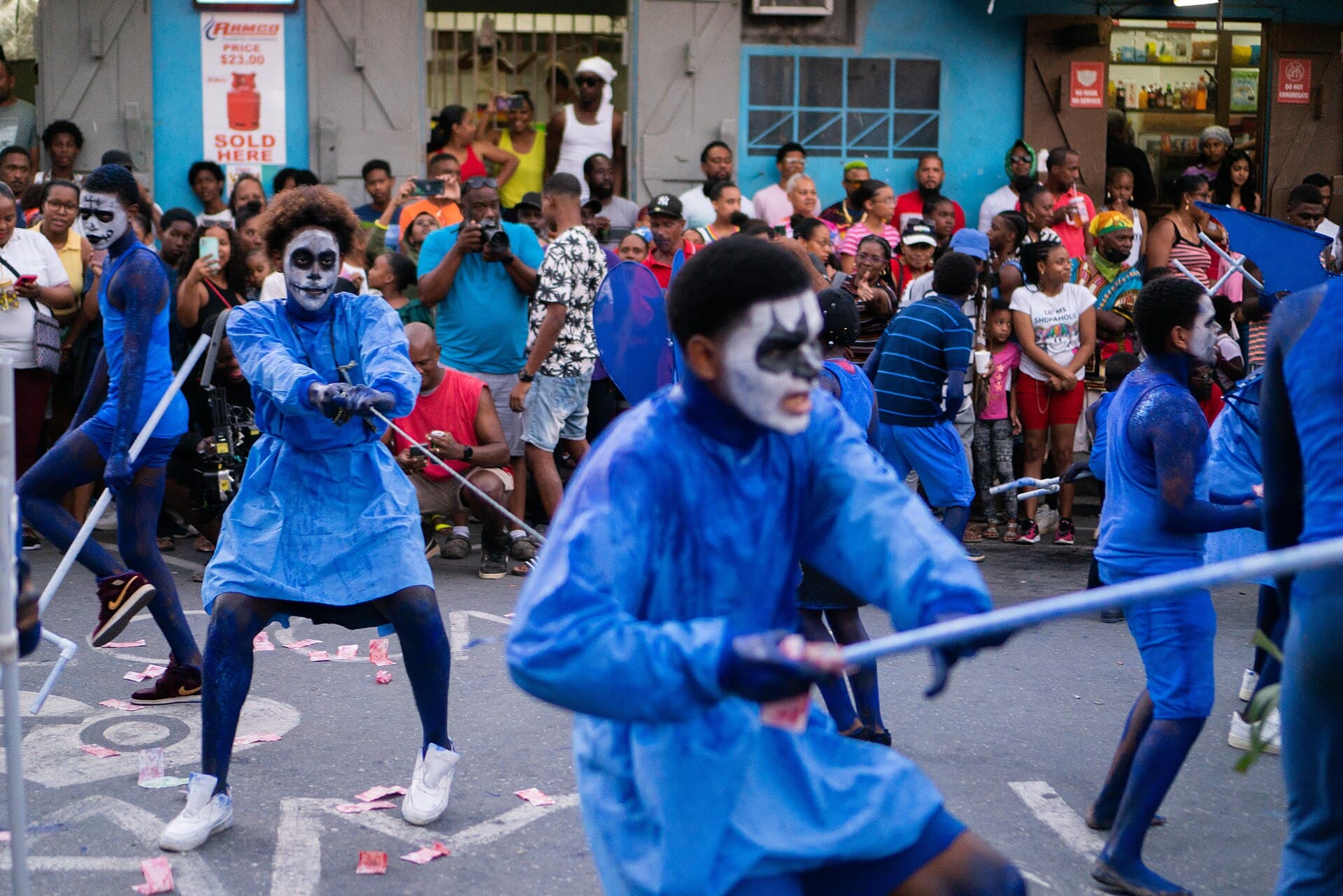
Image credit: Lesley Granderson, via Wikimedia Commons, CC BY-SA 4.0
Long before feathers and beads ruled the road, Trinidad Carnival belonged to a cast of characters you could recognise from a block away: devils dripping in molasses, a jester who could spell any word, an outlaw with a coffin for a money box, and a giant striding on stilts past second-floor balconies. Trinis call them traditional mas, or old-time mas, and they are the deepest roots of the festival.
Many of these characters were born in the 1800s as satire. Formerly enslaved Africans and their descendants mocked the French planters and the pretensions of high society, using costume, movement and words as weapons. Some characters are about fear, some are about laughter, and some are about pure spectacle. Knowing a little about each one makes the old mas far more fun to watch, and far easier to respect.
This guide groups the main characters into three families. Most of the descriptions draw on research by the Carnival Institute of Trinidad and Tobago, published by the National Carnival Commission (NCC).1
The devils
Devil mas is one of the oldest and loudest strands of Carnival. In Trinidad the devils are nearly always called "jabs", from the French Creole word for diable, devil.2 They come in many forms, and some of them will want a little money from you.
Jab Jab
The Jab Jab is the dressed-up devil. His costume is a kandal (satin knickers) and a satin shirt with points of cloth at the waist, each hung with bells, so you often hear a Jab Jab before you see him. A shaped panel on the chest glitters with swansdown, rhinestones and mirrors, and his hood carries stuffed cloth horns.2
The real business is the whip. A Jab Jab carries a thick whip of plaited hemp, which he swings and cracks with menace. Jab Jabs face off against each other, and the NCC notes that these whips can reduce a rival's costume to threads.2 Give them plenty of room.
Jab Molassie
The Jab Molassie, or molasses devil, is one of the oldest forms of devil mas. His origins go back to the sugar estates: after emancipation, people who had toiled in the cane fields daubed themselves in molasses, cheap and close at hand, as a disguise and a way of playing mas with almost nothing.3
He wears horns and a wire tail, carries a pitchfork, and moves to the beat of biscuit tins or pitch-oil pans, with a whistle to punctuate his leaps. Some Jab Molassies wear a rope or chain around the waist, held by another devil who struggles to restrain them. They throw themselves to the ground, rush at spectators and threaten to rub off on anyone nearby, which is why so many people choose to "pay the devil" with a dollar or two.3 Today the sticky coat may be molasses, mud, chocolate syrup or paint in blue, red, green, white or yellow.3
The blue devils of Paramin
Paramin is a village in the hills north of Port of Spain, and as far back as anyone there can remember it has been home to rival blue devil troupes. On Carnival Monday the village becomes their home ground, with blood-curdling hoots, menacing dances to the drums, fire-breathing and pitchforks waved at delighted onlookers.4 The blue devils are among the most celebrated of all the traditional masquerades: a favourite of photographers and filmmakers, and a reliable crowd-pleaser.4
Bookman
Traditional devil mas once came as a whole band with a strict cast list: imps, beasts, a King Imp, a Key Man who must "open the water" before the band can cross, glamorous Ladies in Waiting, and rulers such as Lucifer and Satan.1 One of the most striking rulers is the Bookman, also called Beelzebub or the Prince of Dark. He wears a long gown and a large, grotesque horned mask, and he carries a pen in one hand and a big book in the other, in which he takes down notes.1 The book is popularly described as a register of souls, so being "written down" by the Bookman is not a compliment.5
Satire and speech mas
Some of the best-loved characters perform with their mouths as much as their costumes. Caribbean Beat groups the Midnight Robber and Pierrot Grenade among the "speech mas" traditions of Trinidad, where the spoken word is the heart of the performance.6
Dame Lorraine
Today the Dame Lorraine appears as a woman dressed in the style of a rich planter's wife, with an exaggerated, padded bust and backside. In the beginning, though, she was not one character but a whole troupe that staged an elaborate skit on Dimanche Gras, the Sunday before Carnival, parodying the French planters' balls.7
The skit mocked not only the planters' grand parties but also their physical failings. Each character had a descriptive French Creole name pointing at some bodily defect, and the big bottom and big bosom were once worn by separate players. Now both are combined in one outfit. In the past, mostly men played Dame Lorraine; these days, mostly women do.7
Pierrot Grenade
The Pierrot Grenade is the scruffy, comic descendant of the old Pierrot, a finely dressed masquerader who posed as a deeply learned scholar. His name shows his link to Grenada. Instead of fine robes, his gown is made from multicoloured scraps of cloth, and where he once wore a wire-mesh mask, the face is now usually painted and a hood worn over the head.8
The NCC calls him the supreme jester of Trinidad Carnival. He prances and twirls with a whip of guava or hibiscus, and above all he delights in showing off his learning, including his ability to spell any word you throw at him, at great length and in his own very creative way.8
Midnight Robber
The Midnight Robber is one of the best known of all the traditional characters. His costume borrows from the American Wild West: an oversized hat with a fringed brim, its crown sometimes shaped like a coffin, a flowing cape decorated with symbols of death, a black satin shirt, black pantaloons and boots, though modern Robbers come in many colours.9
He announces himself with a blast on his whistle, then launches into robber talk: haughty, rolling speeches of threat and self-praise that draw on the Bible, classical literature and Shakespeare.9 Each Robber writes his own legend, a tall tale of fearsome deeds and wicked pedigree, and when two Robbers meet they may try to out-talk each other, all before turning to the crowd for tribute.5 He carries a prop gun, sword or dagger, and a wooden money box shaped like a coffin, which is where your coins are expected to go.9
Baby Doll
The Baby Doll was a common sight at Carnival in the late 1800s. She is a satirical portrait of a young mother with an illegitimate baby, played in a frilly dress, gloves and a large bonnet or mob cap, always carrying a doll.10
Her performance is pure street theatre. She stops men in the crowd, loudly accuses them of being the father, and shames them into handing over money "for milk" or clothes, or simply to make her stop.10 If a Baby Doll picks you, laugh, play along, and find a small note.
Spectacle and street theatre
The third family of characters is about the sheer pleasure of looking: height, colour, dance and parody on a grand scale.
Moko Jumbie
The Moko Jumbie takes its name from West African tradition. Moko is described by the NCC as an orisha, or god, of retribution, and the word "jumbie" (spirit) was added after slavery. The Moko Jumbie was seen as a protector whose great height let him see evil coming before ordinary people could.11
As a masquerade he takes long, balanced strides on stilts that can stand 10 to 15 feet high. In the past he was sometimes partnered by a dwarf in matching costume, without stilts, to make Moko look even taller, and he danced through the streets all day collecting money on a plate from people crowded on balconies and second-floor windows.11 His stilts are often painted in stripes or wrapped in coloured fabric, and he usually wears long trousers or skirts, a simple shirt and sometimes a hat.
Fancy Sailor
Sailor mas arrived in the 1880s, when British, French and American naval ships called at Trinidad. The basic costume is relatively light and affordable: a beret carrying the ship's name, a striped bow-necked jersey, bell-bottomed trousers and black or white shoes. Sailors have their own dances too, with names such as the Crab, Marrico, Rock de Boat, Skip Jack and the Camel Walk.12
The Fancy Sailor grew out of the King Sailor. He wears a papier-mâché headpiece decorated and painted to look like a bird, animal or plant, and a uniform trimmed with ribbons, medals, braid and swansdown to match.12 Sailor mas has many other variations, including the Free French Sailor, the Flour Bag Sailor and the Fireman, and it is far from a museum piece: at Carnival 2026, Trinidad All Stars placed second in the large band competition with a sailor band, Sailors Ashore in Japan.13 14
Burrokeet
The Burrokeet takes its name from the Spanish burroquito, little donkey. The costume makes it look as if the dancer is riding a donkey: a decorated donkey head made from coloured paper, a long satin skirt over the "animal's" body with a sisal tail, and reins and bridle of coloured cord. The rider wears a large matador-style straw hat and dances in imitation of the donkey's movements, sometimes performing a dance called Burriquite that originated in Venezuela.15
Minstrels
Minstrel bands are groups of singers who play instruments such as the banjo, maracas, clappers and rattles. In Trinidad the Minstrels wore whiteface, deliberately turning the tables on the white American minstrels who performed in blackface and claimed to imitate Black people. They sang plantation songs and American tunes like "Swanee River", dressed in Uncle Sam tailcoats, pinstripe trousers, white gloves and felt top hats.16 It is satire with a sharp edge, and worth understanding before you laugh along.
Fancy Indian and Wild Indian
Indian mas is among the most colourful of the traditional forms. The NCC lists five types: Black Indians, Blue Indians, Fancy Indians, Authentic Indians and the Guarahoon, also called Wild Indians or Red Indians.17
The Fancy Indian is the most popular. It is an imaginative, deliberately non-authentic portrayal, built around huge decorated headpieces of feathers, sometimes on bamboo or wire frames, with a supporting structure that can cover the masquerader's whole body. Expect papier-mâché masks, canoes, ostrich plumes, mirrors, beads, totem poles and ribbons.17
The Guarahoon or Wild Indian is the oldest form of Indian mas. It is based on the Warao, an Amerindian people of Venezuela, just across the Gulf of Paria. The Guarahoon dresses in red and speaks a language of his own.18
Seeing traditional mas today
Old-time mas has never disappeared. You will find devils, Robbers, Pierrots, Dame Lorraines and Moko Jumbies at cultural shows, community events and competitions across the Carnival season, and the stick-fighting art of kalenda, with its own chantwells and drums, has traditionally held its finals in the early hours of Carnival Friday, according to the NCC.19 For a first-timer, an hour spent with the traditional characters is the quickest way to understand what Carnival is really about: freedom, wit and the right to take over the street.
Sources
-
National Carnival Commission: Traditional Mas Characters, Devils and Demons (archived) (opens in a new tab) ↩ ↩2 ↩3
-
NCC: Traditional Mas Characters, Devils and Jab Jab (archived) (opens in a new tab) ↩ ↩2 ↩3
-
NCC: Traditional Mas Characters, Jab Molassie (archived) (opens in a new tab) ↩ ↩2 ↩3
-
Wikipedia: List of Trinidad and Tobago Carnival character costumes (overview and further references) (opens in a new tab) ↩ ↩2
-
Caribbean Beat: Making the Caribbean with mas (opens in a new tab) ↩
-
NCC: Traditional Mas Characters, Dame Lorraine (archived) (opens in a new tab) ↩ ↩2
-
NCC: Traditional Mas Characters, Pierrot Grenade (archived) (opens in a new tab) ↩ ↩2
-
NCC: Traditional Mas Characters, Midnight Robber (archived) (opens in a new tab) ↩ ↩2 ↩3
-
NCC: Traditional Mas Characters, Baby Doll (archived) (opens in a new tab) ↩ ↩2
-
NCC: Traditional Mas Characters, Moko Jumbie (archived) (opens in a new tab) ↩ ↩2
-
NCC: Traditional Mas Characters, Fancy Sailor (archived) (opens in a new tab) ↩ ↩2
-
Trinidad Guardian: Lost Tribe cops 2026 triple crown (opens in a new tab) ↩
-
TTT: Five and counting, The Lost Tribe reigns again as Senior Large Band of the Year (opens in a new tab) ↩
-
NCC: Traditional Mas Characters, Burrokeet (archived) (opens in a new tab) ↩
-
NCC: Traditional Mas Characters, Minstrels (archived) (opens in a new tab) ↩
-
NCC: Traditional Mas Characters, Fancy Indian (archived) (opens in a new tab) ↩ ↩2
-
NCC: Traditional Mas Characters, Guarahoon / Wild Indian / Red Indian (archived) (opens in a new tab) ↩
-
NCC: Traditional Mas Characters, Calinda or Kalenda (archived) (opens in a new tab) ↩
Words from this story
- Mas
Short for masquerade. Mas means the costumed side of Carnival as a whole, from feathered 'pretty mas' bands to traditional characters, and it can also mean a single costume.
- Jab Jab
A traditional devil mas character. The Jab Jab wears satin knickers and a satin shirt with pointed cloth panels hung with bells, a decorated chest panel and a hood with stuffed cloth horns, and swings and cracks a thick whip of plaited hemp.
- Moko jumbie
A stilt-walking masquerade character towering over the crowd on stilts that can be 10 to 15 feet tall, in bright costumes with long pants or skirts. Seen as a protector who could spot danger from on high, the moko jumbie has West African roots. Once thought to be dying out, it has been revived by community groups training young stilt-walkers, some of them since the 1980s.
Frequently asked questions
What is traditional mas?
Traditional mas (also called old-time mas) is the family of Carnival characters that grew up in Trinidad in the 1800s and early 1900s, such as the Jab Jab, Dame Lorraine, Pierrot Grenade, Midnight Robber and Moko Jumbie. Each has its own costume, movement and, often, its own speech or song, and many began as satire of colonial society.
Why do people say 'pay the devil'?
Devil characters like the Jab Molassie jump, wrestle and pretend to smear spectators. Handing over a small coin or note is the traditional way to make them move on, so many bystanders happily 'pay the devil' to keep their clothes clean.
What is robber talk?
Robber talk is the boastful, theatrical speech of the Midnight Robber. Blowing a whistle to get attention, the Robber delivers grand threats and tales of his own wickedness, drawing on the Bible, classical literature and Shakespeare, before 'robbing' the audience for coins dropped into his coffin-shaped money box.
Where can visitors see the Paramin blue devils?
The blue devils of Paramin perform in their home village in the hills north of Port of Spain on Carnival Monday. Expect blue paint, pitchforks, drumming and a lot of mock menace, so wear clothes you do not mind getting marked and carry small change.
Further reading and references
- National Carnival Commission: Traditional Mas Characters (archived pages, Carnival Institute of Trinidad and Tobago research)
- NCC: Traditional Mas Characters, Midnight Robber (archived)
- NCC: Traditional Mas Characters, Moko Jumbie (archived)
- Caribbean Beat: All about blue (Paramin blue devils)
- Caribbean Beat: Making the Caribbean with mas
Facts last checked 3 October 2026. Read our editorial standards or send a correction.
Keep exploring
- HistoryCanboulay: The Cane Fires and the 1881 Riots That Made CarnivalThe story of Canboulay (cannes brûlées), from cane fires on slavery-era estates to emancipation torch processions, kalinda stickfighting, the 1881 Canboulay Riots, and the re-enactment held before dawn on Carnival Friday.Read more
- HistoryThe Origins of Trinidad Carnival: From Plantation Balls to a National FestivalHow Trinidad Carnival began with French Creole planters after the 1783 Cedula of Population, how the formerly enslaved claimed the streets after emancipation, and how it became the national festival run by the NCC.Read more
- HistoryJ'ouvert in Trinidad: Meaning, History and How to PlayWhat does J'ouvert mean? Trinidad J'ouvert history from Canboulay to mud and paint bands, plus the 2027 date, what to wear, safety tips and road etiquette.Read more
- HistoryThe Evolution of Pretty MasFrom Harold Saldenah's Roman legions and George Bailey's Africa to Wayne Berkeley's fantasy, Peter Minshall's theatre and today's bikini-and-beads all-inclusive bands: how pretty mas changed, and why people still argue about it.Read more
- HistoryFrom Calypso to Soca: The Sound of Trinidad CarnivalHow kaiso grew from the chantwell's call into calypso, how Lord Shorty invented soca in the 1970s, and how the Road March, Soca Monarch and stars from Kitchener to Machel shaped the soundtrack of Carnival.Read more
- Timeline1880s: The sailors come ashoreSee where this story sits among the other turning points of Carnival history.Read more