History
The Origins of Trinidad Carnival: From Plantation Balls to a National Festival
By Soca Carnival EditorsUpdated 7 min read
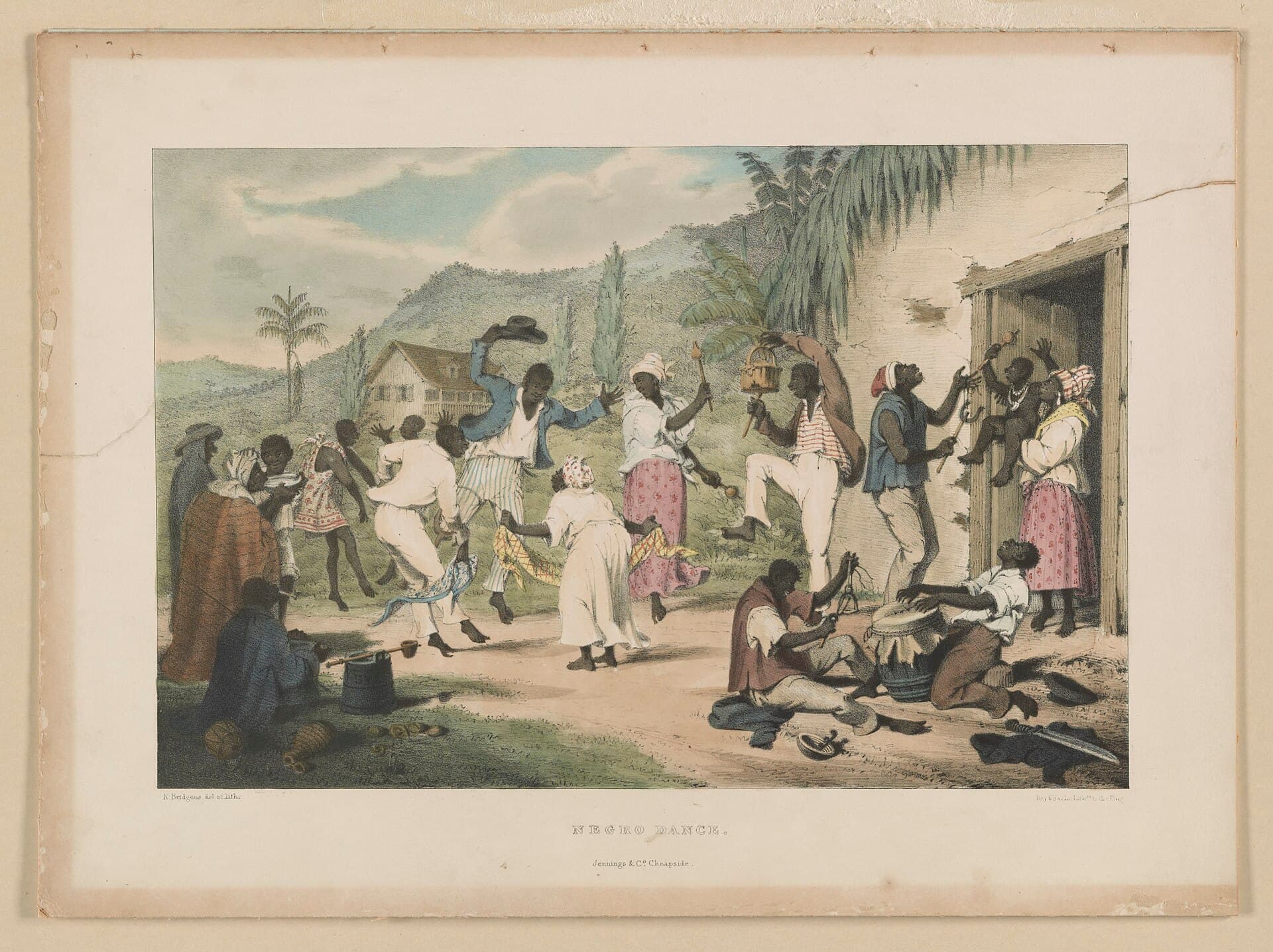
Image credit: Richard Bridgens (artist) and Day & Haghe (lithographers), via Wikimedia Commons, Public domain
Trinidad Carnival is often called the greatest show on earth, a festival that pulls the whole country, and a good part of its diaspora, onto the road every year. It did not start that way. For most of its first century it was two festivals running side by side: one in the ballrooms of the plantation elite, and one in the yards and streets of the people they enslaved. The story of how the second one took over the first is the story of Trinidad itself.
A Spanish island opens its doors
When Columbus claimed Trinidad for Spain in 1498, the island offered none of the gold Spain was looking for, and for more than 250 years it was largely ignored. To change that, the Spanish Crown issued a Cedula of Population in 1776 and a second, more far-reaching one in 1783, opening the island to Catholic settlers.1 Planters arrived from the French West Indian islands of Martinique, Guadeloupe and Saint-Domingue, along with free people of colour and the Africans they enslaved.1
The newcomers brought their language, food, dress and customs, including the Catholic tradition of feasting before Lent. Britain captured Trinidad in 1797 and made it a crown colony, but the season between Christmas and Lent remained a time of great merrymaking and feasting for the French and English alike.1
The planters' Carnival
From 1783 onwards, the French developed what the National Carnival Commission describes as "a season of gay and elegant festivities extending from Christmas to Ash Wednesday", with dinners, balls, concerts and hunting parties.2 Nineteenth-century writers described house-to-house visiting and fêtes champêtres, country-style parties, among the white upper class. The British, for their part, imposed martial law over the Christmas season, opened with military exercises.1
Masking was part of the fun. Before emancipation, the elite dressed up as nègres jardin (field slaves) and mulâtresses, and even re-enacted the cannes brûlées, the slavery-era scramble to put out cane fires.1 The Dame Lorraine character, still seen in traditional mas today, began as an imitation of the elegant costumes and courtly dances of the French planters, later recreated with rags and exaggeration by the formerly enslaved.1
The yard and the compound: parallel traditions
Between 1783 and 1838, Carnival in the streets belonged to the white elite. Africans and people of mixed race were forbidden by law to take part in street festivities.1 That did not mean they did not celebrate. In their own compounds they held their own festivities, and the balls, parades and pomp of martial law gave them material for some of the earliest masquerades: watching, copying and mocking the people who ruled them.1 As CBC Arts put it, the enslaved knew about the planters' lavish masquerade but were barred from it, "so, they created their own mas".3
That instinct for satire, for turning the powerful into a costume, runs through Trinidad Carnival to this day, from the Pierrot Grenade, who mocks the learned scholar in rags, to the political placards of J'ouvert.1
Emancipation changes everything
Slavery in the British Caribbean formally ended on 1 August 1834, though most of the formerly enslaved were held under a so-called apprenticeship system until full freedom on 1 August 1838.4 Trinidad and Tobago has marked 1 August as Emancipation Day, a national holiday, since 1985.5
Freedom opened the door to full African participation in Carnival.1 NALIS dates the start of the street parades to 1839.1 At first, freed Africans celebrated the anniversary of emancipation by re-enacting the cannes brûlées, now as a symbol of their changed status, with masking, dancing, stickfighting and mockery of the whites. After about a decade this celebration, Canboulay, moved into the pre-Lenten season, starting at midnight on the Sunday before Carnival.1,2
Meanwhile the whites were preoccupied with the economic shock of emancipation, labour shortages and the slow eclipse of French influence by British rule. Whites and coloureds withdrew from the street festival, and Africans took it over "as an expression of their new-found freedom".1 The drum replaced the fiddle, the poui stick replaced the sword, and African dances such as the kalinda and bamboula took the floor.1 (Read the full story in our Canboulay history.)
Who owns the streets?
The second half of the 19th century was a long fight over that question. The respectable classes called the African-led festival of roughly 1860 to 1896 the "jamette" Carnival, after the people of the barrack yards of east Port of Spain: stickfighters, chantwells, labourers and sex workers.1 Newspapers condemned it, and the colonial government passed law after law banning drumming, lighted torches and "obscene songs and dances".1
The clash came to a head in 1881, when police chief Captain Arthur Baker tried to stop the Canboulay procession in Port of Spain and was beaten back in a street fight that injured 38 of his 150 men.6 The governor confined the police to barracks and let Carnival go on. But in 1884 the Peace Preservation Ordinance allowed the authorities to ban torchlight processions and large street bands, and the night-time Canboulay was never revived.6 The celebration moved to daybreak on Carnival Monday and became J'ouvert, with tamboo bamboo standing in for the banned drums.1
The twentieth century: the elite comes back
In the first two decades of the 1900s, with some of its "coarser" elements purged, the upper classes gradually returned to Carnival, though at first only on decorated trucks and lorries, at a safe distance from the street mas, and at fancy dress balls, club dances and house parties.1 Smithsonian's Barbara Ehrenreich, citing historian Hollis Liverpool, notes that the costumed "pretty mas" grew partly out of these upper-class efforts to tame the African-derived side of the festival.7
Some milestones from the decades that followed:
- 1920s to 1948: the Les Amantes de Jesus Society, led by M. Joseph Scheult, staged an annual charity ball and stage spectacle on Carnival Monday night.1
- Around 1935: metal containers began replacing tamboo bamboo, and the steelband was born from the yards of Port of Spain.2
- 1942 to 1945: no Carnival at all, because of the Second World War.1
- 1948: the Dimanche Gras Show was inaugurated on Carnival Sunday night, the night that had once belonged to Canboulay. It is still the premier show of Carnival weekend.1
- 1955: the Band of the Year award was introduced as mas became more competitive.1
The CDC and the golden age
In the 1950s, with nationalism rising, the government decided Carnival was too important to be left to private enterprise. It set up the Carnival Development Committee (CDC) in 1957 to manage the celebrations, and the festival began to take its modern shape, with J'ouvert opening Carnival Monday.1 More funding and structure brought what NALIS calls the "Golden Age of Carnival".1
It was a golden age for designers too. In 1957, 21-year-old George Bailey of Woodbrook won Band of the Year with Back to Africa, a deeply researched portrayal that pushed every other bandleader to raise their game.1 Harold Saldenah, Irvin McWilliams, and Edmond and Lil Hart (credited with introducing the bathing suit as the base of the costume, the root of today's "bikini mas") all built their legends in these decades.1 (See how pretty mas evolved.)
Independence and a national festival
Trinidad and Tobago became an independent nation on 31 August 1962.8 Carnival became one of the clearest expressions of the new national identity: when Independence came, headpieces from bandleader Cito Velasquez's band Fruits and Flowers were chosen to decorate downtown Port of Spain for the celebrations.1
In 1963 the Silver Stars Steelband of Newtown won Band of the Year with Gulliver's Travels, the only time in the 20th century that a steelband took the title.1 Irvin McWilliams's Wonders of Buccoo Reef (1971) and Know Your Country (1978) turned mas toward local themes,1 and from 1976 designer Peter Minshall, beginning with Paradise Lost for Stephen Lee Heung, brought satire and theatre back into pretty mas.1 In 1972 Carnival was even moved to May because of a polio epidemic.1
The NCC and Carnival today
In 1991 Parliament replaced the CDC with the National Carnival Commission, established by Act 9 of 1991 and assented to on 5 August 1991.9 Its mandate covers the regulation and coordination of Carnival activities held under government auspices, the rules of Carnival, and the promotion of Carnival-related industries.9 Its board includes nominees from the organisations representing steelbands, Carnival bands and calypsonians,9 a reminder that the people who made Carnival now help run it.
Today Carnival is Trinidad and Tobago's main tourist attraction, and it has inspired carnivals wherever Trinbagonians have settled, including New York, Toronto, Miami and London.1 Yet the old two-stream festival is still visible if you know where to look: in the mud and devils of J'ouvert at dawn, the stickfighters at the Canboulay re-enactment, and the feathered bands crossing the stage on Tuesday.
Sources
-
NALIS, "Mama Dis is Mas" Carnival subject guide (archived copy) (opens in a new tab) ↩ ↩2 ↩3 ↩4 ↩5 ↩6 ↩7 ↩8 ↩9 ↩10 ↩11 ↩12 ↩13 ↩14 ↩15 ↩16 ↩17 ↩18 ↩19 ↩20 ↩21 ↩22 ↩23 ↩24 ↩25 ↩26 ↩27 ↩28 ↩29 ↩30 ↩31 ↩32
-
National Carnival Commission, "History of Carnival and its elements" (opens in a new tab) ↩ ↩2 ↩3
-
Lucius Dechausay, "Mas as protest: How traditional Carnival was born out of resistance", CBC Arts, August 2018 (opens in a new tab) ↩
-
UK Parliament, "The West Indian colonies and emancipation" (archived copy) (opens in a new tab) ↩
-
NALIS, "Emancipation Day" subject guide (archived copy) (opens in a new tab) ↩
-
Bridget Brereton, "The Captain and the Canboulay", Trinidad Express, 31 January 2012 (opens in a new tab) ↩ ↩2
-
Barbara Ehrenreich, "Up Close at Trinidad's Carnival", Smithsonian Magazine, February 2009 (opens in a new tab) ↩
-
Parliament of the Republic of Trinidad and Tobago, "History of Parliament" (opens in a new tab) ↩
-
National Carnival Commission, "About NCC" (opens in a new tab) ↩ ↩2 ↩3
Words from this story
- Mas
Short for masquerade. Mas means the costumed side of Carnival as a whole, from feathered 'pretty mas' bands to traditional characters, and it can also mean a single costume.
- J'ouvert
The pre-dawn street party that opens Carnival, starting in the dark hours of Carnival Monday (from 4am). Revellers play 'dutty mas' in mud, paint, oil, cocoa, powder and old clothes, chipping through the streets behind music trucks until the sun is up. Traditional characters like blue devils and jab jabs come out too.
- Dimanche Gras
Carnival Sunday, and the big night-time show held that evening at the Queen's Park Savannah in Port of Spain. In 2026 the National Carnival Commission billed it as the Senior Kings and Queens of Carnival finals; in past years the show has also crowned the National Calypso Monarch. J'ouvert follows in the early hours of the next morning.
Frequently asked questions
Who brought Carnival to Trinidad?
French and French Creole planters, along with free people of colour and the Africans they enslaved, who settled in Trinidad after Spain's 1783 Cedula of Population opened the island to Catholic immigrants. Their pre-Lenten season of balls and masquerades was the seed of Carnival.
When did Africans start playing Carnival in the streets?
After emancipation. Slavery formally ended on 1 August 1834 and full freedom came on 1 August 1838. NALIS dates the start of street parades to 1839, and freed Africans soon brought Canboulay, drumming and stickfighting into the Carnival season.
Was Carnival ever cancelled in Trinidad?
Yes. There was no Carnival from 1942 to 1945 because of the Second World War, and in 1972 Carnival was moved to May because of a polio epidemic.
Who runs Trinidad Carnival today?
The National Carnival Commission (NCC), established by Act 9 of 1991. It replaced the Carnival Development Committee, which the government set up in 1957.
Further reading and references
- NALIS, 'Mama Dis is Mas' Carnival subject guide (archived)
- National Carnival Commission, History of Carnival and its elements
- National Carnival Commission, About the NCC
- Bridget Brereton, 'The Captain and the Canboulay', Trinidad Express (2012)
- UK Parliament, The West Indian colonies and emancipation (archived)
- NALIS, Emancipation Day subject guide (archived)
- Parliament of Trinidad and Tobago, History of Parliament
- Barbara Ehrenreich, 'Up Close at Trinidad's Carnival', Smithsonian Magazine (2009)
- CBC Arts, 'Mas as protest: How traditional Carnival was born out of resistance' (2018)
- Errol Hill, The Trinidad Carnival: Mandate for a National Theatre (1972), Open Library record
Facts last checked 3 October 2026. Read our editorial standards or send a correction.
Keep exploring
- HistoryCanboulay: The Cane Fires and the 1881 Riots That Made CarnivalThe story of Canboulay (cannes brûlées), from cane fires on slavery-era estates to emancipation torch processions, kalinda stickfighting, the 1881 Canboulay Riots, and the re-enactment held before dawn on Carnival Friday.Read more
- HistoryJ'ouvert in Trinidad: Meaning, History and How to PlayWhat does J'ouvert mean? Trinidad J'ouvert history from Canboulay to mud and paint bands, plus the 2027 date, what to wear, safety tips and road etiquette.Read more
- HistoryThe Evolution of Pretty MasFrom Harold Saldenah's Roman legions and George Bailey's Africa to Wayne Berkeley's fantasy, Peter Minshall's theatre and today's bikini-and-beads all-inclusive bands: how pretty mas changed, and why people still argue about it.Read more
- HistoryTraditional Mas Characters of Trinidad CarnivalMeet the devils, jesters, robbers and stilt walkers of old-time mas: who the Jab Jab, Dame Lorraine, Midnight Robber, Moko Jumbie and friends are, where they came from, and how to enjoy them today.Read more
- HistoryFrom Calypso to Soca: The Sound of Trinidad CarnivalHow kaiso grew from the chantwell's call into calypso, how Lord Shorty invented soca in the 1970s, and how the Road March, Soca Monarch and stars from Kitchener to Machel shaped the soundtrack of Carnival.Read more
- Timeline1783: The Cedula of PopulationSee where this story sits among the other turning points of Carnival history.Read more